

This article was provided by the Fremont County Museum System and originally published on PitchEngine.

On the demand for railroad ties from the Chicago & Northwestern Railroad the Tie Drive started in 1914 and lasted until 1987 with the end of timbering. In the beginning of the Tie Drive the Wind River was used as a means of transporting the ties from above Dubois down to Riverton where the ties were hauled from the river to the tie yard. These ties, during the time of the river transport, saw over 70 miles of rough terrain and water. The ties came down hand-built flumes through the Warm Springs canyon, down into the rough waters of the Wind River, flowing over boulders, jamming up and being released, then spilling over and through Diversion Dam and ending up along the banks of the Wind River near Riverton.
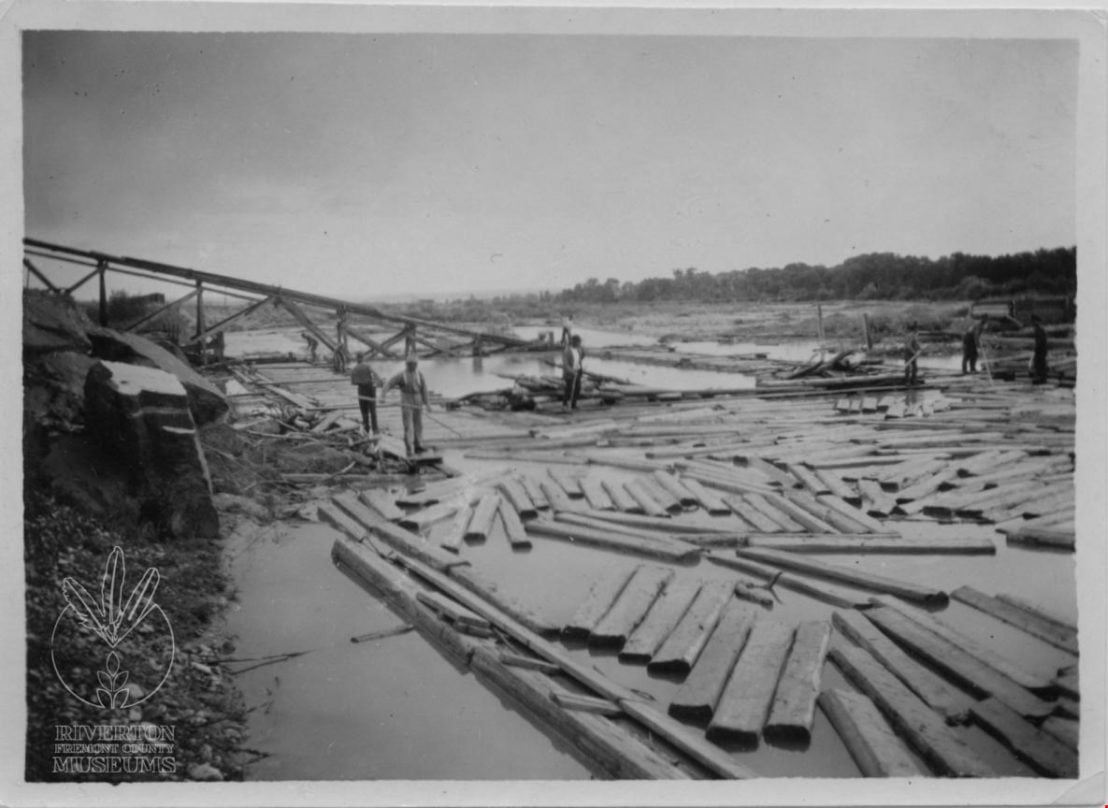
Image of tie hacks floating ties down the Wind River for use in building railroads. Photo courtesy of Fremont County Museums
Image courtesy of Fremont County Museum System

For the men in Dubois, their job was to cut and hew the timber to shape and wrestle these logs down to the flume. For the Riverton men, it was up to them to haul the water logged ties onto land and stack them into the tie yard. The use of the river to transport the ties ended in 1947 after trucks were brought in. This modern convenience allowed the tie company to haul the ties continuously rather than once a year. With continuously bringing in ties, the workers were paid monthly rather than yearly.

This photograph shows ties that have been caught and guided into a pool, off of the Wind River. The ties are then guided to the conveyor located in the background. Men with pike poles are seen standing on ties, guide the ties and preventing dams. This photograph was taken well before 1947, prior to when river operations were closed in favor of trucks for transportation.

Re-discover the Winds by visiting the Dubois Museum, the Pioneer Museum in Lander or the Riverton Museum. Visit www.fremontcountymuseums.com for a complete schedule of events, latest newsletter and the latest Wind River Mountaineer.Sponsors list
Follow the Moments That Make Wind River Country


See Wind River Country as it happens, on the trail, in town and out on the land. Follow along for real moments from real people, and share your own journey by tagging @windrivercountry.

📍South Pass City, Wyoming 

While you can visit this historic gold mining town from the end of May - mid October, save the date for Gold Rush Days - July 11 & 12.

Photo: Wind River Country

#Wyoming #WindRiverCountry #ThatsWY
There's no place quite like old Wyo'. 

Photo: Journal of Lost Time

 #WindRiverCountry #Wyoming #ThatsWY #CowboyState #Beautiful
When the mountains call, there’s only one thing to do. Go. 

Photo: Journal of Lost Time 

#Wyoming #WindRiverCountry
Ready to learn more about the wild horses of the West? The Wind River Wild Horse Sanctuary - which is located on the Wind River Indian Reservation - has a visitor center with an interpretive display, and also offers guided tours.
Plan your trip at the link in our bio. 

Photo: Melissa Hemkin

#WindRiverCountry #Wyoming #ThatsWY #CowboyState
This is what we like to call the perfect summer day in Wind River Country.

Photo: Wind River Country/Paula McCormick 

#WindRiverCountry #Wyoming #ThatsWY #CowboyState
Combine history and modern-day culture at the Eastern Shoshone Indian Days Powwow, June 19-21. Held in Fort Washakie, the event includes a parade, hand game tournament, drum contest, Indian rodeo and relay races and Grand Entries. 

Find more information at the link in our bio. 

#WindRiverCountry #Wyoming #ThatsWY #CowboyState
Plan a trip to Lander and Lander Brewfest to enjoy 80+ beers made all across the Mountain West on June 12-13. We hope to see you there - cheers! 

Photo: Wyoming Office of Tourism

#WindRiverCountry #Wyoming #ThatsWY #CowboyState
Spring storms and lush landscapes. 

Start planning your visit at the link in our bio. 

Photo: Scott Copeland 

#WindRiverCountry #Wyoming #ThatsWY #CowboyState